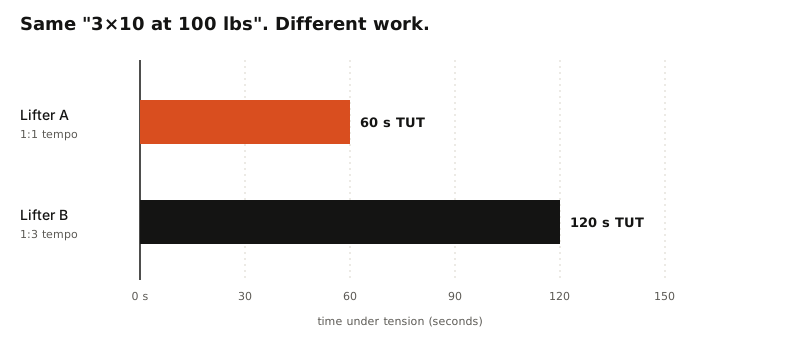
Two lifters walk into a gym and write “3×10 at 100 lbs” in their training logs. One walks out 90 seconds later with the work done. One walks out 220 seconds later. Same sets, same reps, same load. They wrote down the same workout. They did not do the same workout.
The integer in your set log can’t see the difference. Your body did.
What time under tension actually is
Time under tension — TUT — is the number of seconds, in a set, that your muscle was actually loaded. Not the seconds between racking and unracking. Not the duration of the set as a stopwatch sees it. The seconds the force was above the baseline you started at.
In tensr, that baseline comes from the sensor. The instant force crosses it, a rep starts. The instant it falls back below, the rep ends. The sum of those intervals across a set is your set TUT, in seconds. The sum across a session is your session TUT, in seconds. There’s no formula to memorize. It’s the time the load was on you, measured directly.
Why it matters
A decade of hypertrophy research keeps converging on the same answer: mechanical tension sustained over time is the primary driver of muscle growth. More than peak load. More than rep count. The signal your body responds to is the integral, not the headline.
Two consequences fall out of that.
Two identical-on-paper sets can produce wildly different stimuli. A 1:1-tempo set of ten reps takes about 20 seconds. The same set at a 1:3 tempo takes about 40. Same load, same reps, twice the tension exposure. If a tempo session ever felt harder than it “should” have, this is why.
For variable resistance, TUT is one of the only honest comparisons available. Bands, chains, cable curves — “3×10 with the heavy band” hides a different total load every time you do it. Different starting tension. Different hand position. Different stretch. Reps and load lie. Seconds-loaded does not.
Once it’s on a screen, it’s hard to go back to counting.
What to track together
TUT lives at three scopes. Each one changes a different decision.
| Scope | What it measures | What it tells you to change |
|---|---|---|
| Rep TUT | Seconds the load was on you for one rep. | Tempo. Slow the eccentric, the rep TUT goes up. |
| Set TUT | Total seconds-loaded for the set. | When to stop. Hit your target, the set ends — regardless of rep count. |
| Session TUT | Total seconds-loaded for the session. | Today’s dose. Are you under, on, or over? |
A traditional set log records only reps. tensr records all three scopes side by side. The interesting moments are when they disagree. Same set TUT but half the rep TUT means you doubled your reps and rushed each one. Same session TUT but twice the set TUT means you cut the number of sets but loaded each one harder. The rep-set-session triangle is the smallest set of dials that keeps you honest about what actually changed week to week.
This post is the gateway. The next one — on impulse — takes the same idea one step further by weighting time by force. TUT counts the seconds the load was on; impulse counts how heavy those seconds were. Both numbers are useful; impulse is the upgrade.
What gear it needs
TUT is honest at every sample rate we support. It’s an integral, and integrals are forgiving — even an 8 Hz crane scale gives you a TUT number you can trust to within a few percent. That’s the whole reason TUT is the front door: the same set on a Tindeq Progressor, a Weiheng WH-C06, and a KForce-Link gives you the same answer.
If you’re shopping for your first sensor, TUT is one of the metrics that does not require you to spend a lot. (Some metrics — rate of force development, rep-level form analysis — do. Those posts will be honest about which gear to pair with them.)
What to do tomorrow
Before your next set, pick a target set TUT and hit it. Some defaults to start from:
- Hypertrophy: 30 seconds.
- Strength: 15 seconds.
- Endurance / rehab: 45–60+ seconds.
Run the set until the screen says you’ve hit the target, regardless of how many reps that took. The first time you do this, you’ll notice your old “3×10” sets were either overshooting or — more often — undershooting what you actually intended. That gap is the work you’ve been doing without doing.
Don’t worry yet about whether the reps were good reps. Tempo and effective reps are the next two posts; they layer on top of this one. For now, just get the seconds.
The number is either bigger than last week or it isn’t. There’s no negotiation.